10x your team speed
with AI agents.
We help founders and ops teams automate manual workflows, replace spreadsheet and CRM chaos, and deploy AI agents that save real team hours.
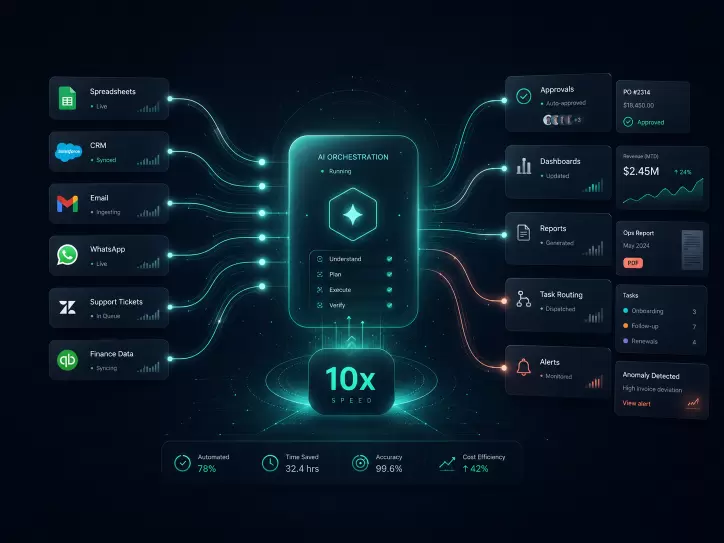
You think your team is slow?
Your workflows are the culprit.
Most operational drag hides inside spreadsheets, status updates, approvals, follow-ups, reporting and manual copy-paste between tools. The tools or lack of them is not the problem. Tackle the misalignment between the tools, data, people and workflows and stop making them fight each other.
Built for founder-led teams drowning in manual work.
Looking for another bloated SaaS tool? Sorry.
This is for operators who know something is broken and want the first automation win shipped.
Core operations still run through spreadsheets.
Your team copies data between CRM, WhatsApp, email, finance tools and dashboards.
Reporting, follow-ups, approvals and reconciliations take too much human time.
You want AI in production, not fragile demos or toy automations.
You need someone who can think like a founder and ship like an engineer.
Four ways we remove operational bottlenecks.
Every engagement starts with one painful workflow. No decks, no discovery theatre; we look at what your team actually does all day and where automation can remove drag.
AI agents that actually run inside your business
Agents connected to your CRM, email, support tools, databases and internal workflows, with guardrails, evaluations and observability.
Automate the repetitive 80%
Lead routing, follow-ups, reporting, onboarding, invoice workflows, approvals, reconciliation and recurring ops tasks.
Replace fragile spreadsheets with real systems
Custom dashboards, approval flows, audit trails, role-based access and operational control panels built around your process.
A hands-on AI automation leader for your team
We embed with your team, identify high-ROI automation opportunities, prioritize the roadmap and ship working systems.
What can be automated?
If a workflow is repetitive, rule-heavy, approval-heavy or involves copying context between tools, it is a strong automation candidate.
Lead capture from forms, WhatsApp, email and ads; qualification; CRM updates; follow-up reminders; proposal drafts; sales summaries.
Task assignment, approval workflows, vendor coordination, internal request tracking and daily or weekly status reports.
Invoice generation, payment reminders, reconciliation, expense approvals and MIS reporting.
Tier-1 support agents, ticket classification, suggested replies, escalation routing and knowledge-base search.
Daily business digest, exception alerts, KPI dashboards, approval queues and what-needs-my-attention summaries.
Live dashboards, scheduled reports, anomaly alerts and automated commentary on movement across key metrics.
From spreadsheet sprawl to shipping autonomy in 90 days.
Map
Workflow audit, tool and data map, automation opportunity list, ROI/risk scoring and a 90-day roadmap.
Prototype
Working v1, real data integration, user feedback loop and a clear success metric. For focused workflows, this can happen in week three.
Productionize
Guardrails, monitoring, error handling, human approval points, runbooks and team handover.
Compound
Quarterly roadmap, reusable components, additional workflow automations and team enablement.

Founder credibility. Engineer execution.
I'm a 2007 IIT Bombay graduate (B.Tech, Computer Science) and a 2012 IIM Bangalore MBA. I've spent most of my career as a founder, building, scaling and eventually selling startups across payments and SaaS.
Today I help founders and operators do more with smaller teams. Whether that's an agent that handles tier-1 support, a workflow that closes the books in hours instead of days, or an internal tool that finally retires the master spreadsheet, if it can be automated, I'll find it and ship it.
I currently run CoralMango Solutions Pvt Ltd.
Moving past simple recommendations, we actually build and ship the systems.
Recent automation wins.
Reporting automation
Team prepared weekly reports manually across scattered sheets.
Automated dashboard plus email digest for faster decisions and fewer errors.
AI support assistant
Repeated support queries were handled manually with inconsistent responses.
AI drafts answers, searches the knowledge base and routes edge cases to humans.
Spreadsheet replacement
A fragile master spreadsheet controlled approvals and operational status.
Role-based internal tool with audit trails, visibility and fewer broken handoffs.
Founder dashboard
Founder chased updates across teams before knowing what needed attention.
Daily operating view surfaces KPIs, blockers, approval queues and exceptions.
Reliable AI automation, not fragile demos.
AI systems need the same operating discipline as any business-critical software: constraints, monitoring, fallback paths and humans in the loop where judgment matters.
Works with your existing CRMs, spreadsheets, databases, support tools and internal processes.
Uses human approval, evaluations, monitoring, fallback rules and escalation paths where AI accuracy matters.
Designs around how your team already works. Actively avoids idealized process diagrams nobody follows.
Adds automation around your current systems instead of forcing a replacement project first.
Includes runbooks, documentation, handover and team training after launch.
Questions founders usually ask before starting.
Do you only advise, or do you also build?
We both design and ship. The goal is not a strategy deck that sits on a shelf. What you get is production automation your team uses.
What happens in the first call?
We pick one painful workflow, map the tools and people involved, identify failure points and decide whether there is a high-ROI automation path.
Do we need to change our current tools?
Usually no. The first step is to automate around the tools you already use, then replace systems only when there is a strong reason.
How soon can we see a working prototype?
For a focused workflow with accessible data, a working v1 can often ship in week three. Complex workflows need more mapping and integration time.
How do you make AI reliable?
We use human-in-the-loop approval, evaluations, monitoring, fallback rules and clear escalation paths instead of pretending AI is perfect.
What should I send before the first call?
Send a short note about the workflow, tools involved, current pain, who touches it and what a better outcome would look like.
Have a workflow that's killing your team?
Send me a one-paragraph description of the workflow, the tools involved, and what makes it painful. I'll reply with a few sharp questions and possible automation directions.